
McDonnell CBCF Overview
The Cuyahoga County CBCF page identifies the Judge Nancy R. McDonnell Community Based Correctional Facility as a county community-corrections facility in Cleveland. It is not the Cuyahoga County Corrections Center, and it is not an arrest-booking jail. The CBCF About page describes a highly structured, secured setting designed to reduce criminal behavior and divert eligible males convicted of a felony from the state prison system.
The facility is operated by Oriana House under the county's CBCF program and Ohio community-corrections funding. The program population is narrower than the jail population. It serves eligible male felony offenders who have a probationable offense, are assessed as moderate or high risk, and are placed through Cuyahoga County Common Pleas Court. A person arrested yesterday at the county jail does not become a CBCF resident by default. The court, Adult Probation, CBCF Admissions, and program screening control the path.
The county CBCF About page states that the facility is a secure 200-bed community-corrections center.
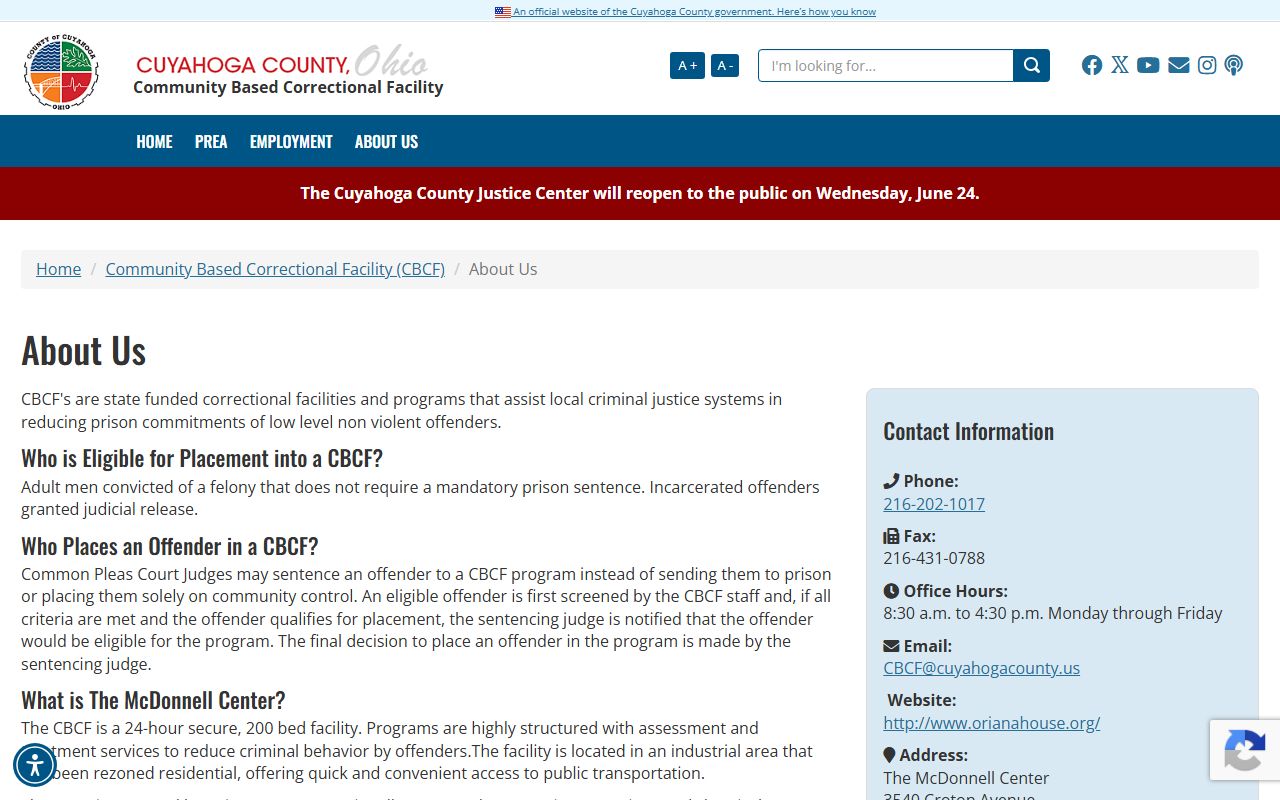
The source screenshot shows why McDonnell CBCF should be treated as a court-sentenced community facility, not as another public jail roster location.
McDonnell CBCF Capacity
The county publishes a clear bed figure for the Judge Nancy R. McDonnell Community Based Correctional Facility. The CBCF About page states that it is a 24-hour secure, 200-bed facility. Current daily population was not located in accessible official source text, so the safest sourced statistic is capacity, not a live resident count. Capacity also does not mean all beds are open or filled on a given day.
The program is meant to function as a prison-diversion and community-control placement. The research notes a mandatory 30-day confinement status and a program duration that can run four to six months, with the screening-guide snippet identifying six months as the maximum. Those program facts come from the CBCF referral and screening material, not from a county jail booking sheet.
McDonnell Resident Lookup
There is no source-supported public McDonnell CBCF roster that works like the Cuyahoga County Sheriff app. The correct lookup path begins with the court case, Adult Probation, CBCF Admissions, and the facility itself. If the person was just arrested, first check the sheriff app or booking desk for the county jail. If a judge sentenced or placed the person into the CBCF, confirm through the court docket and CBCF contacts.
- Check the Cuyahoga County Clerk of Courts criminal docket for the case that ordered community control, CBCF placement, judicial release, or program referral.
- Contact CBCF Admissions at 216-443-4909 when the question concerns eligibility, screening, or arrival instructions.
- Call the facility at 216-202-1017 for resident-related routing, approved visitor questions, mail format, and drop-off rules.
- If the person may still be in jail awaiting transport, use the CCCC booking desk or the county sheriff app before assuming CBCF admission.
- If the person was sentenced to state prison instead of CBCF, use the Ohio Department of Rehabilitation and Correction Offender Search.
The placement sequence matters. The CBCF Referral Information page says defendants must be screened by CBCF Admissions staff, and the sentencing judge makes the final placement decision. Referrals may come from the court, probation officer, or attorney at stages from plea to judicial release.
| Question | Best Record Source | Reason |
|---|---|---|
| Is the person newly booked? | Cuyahoga County Sheriff app or booking desk | New arrests begin in county jail custody, not CBCF programming |
| Was CBCF ordered? | Clerk criminal docket | The judge's order and docket events show court placement |
| Has the person been accepted? | CBCF Admissions | Admissions screens eligibility and placement |
| Is the person in state prison? | ODRC Offender Search | ODRC handles sentenced prison custody, not county CBCF status |
McDonnell CBCF Contact
The McDonnell Center sits at 3540 Croton Avenue in Cleveland. The county's CBCF materials publish the main facility phone, fax, and admissions phone. Use the facility for resident communication rules, visitor approval questions, and drop-off details. Use Admissions when the issue is screening, eligibility, or court referral. Use the court docket for the order itself.
Judge Nancy R. McDonnell Community Based Correctional Facility
3540 Croton Avenue
Cleveland, OH 44115
216-202-1017
Fax: 216-431-0788
CBCF Admissions
Referral and screening contact
Cuyahoga County Common Pleas pathway
216-443-4909
Final placement decision is made by the sentencing judge.
The county page also notes transit access as a practical local detail. Current route numbers were not captured in the source material, so visitors should confirm Greater Cleveland RTA options and the exact entry point before traveling.
McDonnell Visitation Rules
Visitation at McDonnell CBCF is approval-based and differs from CCCC video visitation. The CBCF FAQ says all visitors, including minors, must be approved by the Cuyahoga County Adult Probation Department. Approval typically takes about seven days. Once a visitor is approved, the resident must sign the visitor up for visitation. That means a person cannot treat the CBCF like a walk-in jail visit or a public lobby video terminal.
The CBCF visitor information page gives the money and property drop-off schedule used by families and approved contacts.
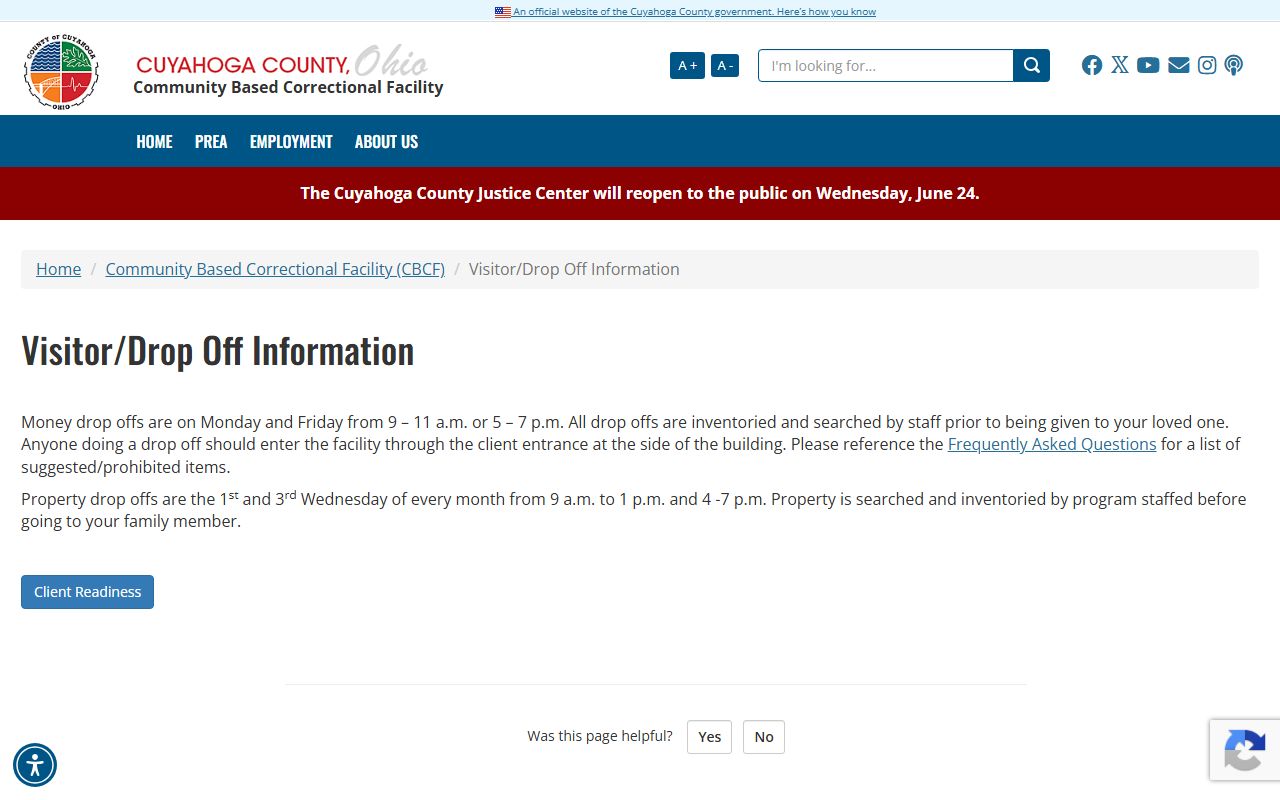
The drop-off schedule is facility-specific and should not be mixed with the CCCC Securus video schedule.
| Activity | Schedule or Rule | Source Detail |
|---|---|---|
| Visitor approval | Adult Probation approval required for all visitors, including minors | Approval typically takes about seven days |
| Visit signup | Resident must sign up the approved visitor | Approval alone does not create a visit |
| Money drop-off | Monday and Friday, 9-11 a.m. or 5-7 p.m. | Use client entrance at the side of the building |
| Property drop-off | First and third Wednesday monthly, 9 a.m.-1 p.m. and 4-7 p.m. | Only approved items should be brought |
McDonnell Mail and Money
McDonnell CBCF mail goes to the facility through Oriana House, not to the CCCC Securus Digital Mail Center in Tampa. The CBCF FAQ gives a direct mail format and says incoming phone calls are not accepted. Residents make outgoing calls from payphones using quarters or phone cards. These rules are shorter than the county jail mail rules, but they are more direct for a program resident.
| Service | Provider or Detail |
|---|---|
| Mail format | Client Name, c/o Oriana House, Inc., 3540 Croton Avenue, Cleveland, Ohio 44115 |
| Incoming calls | Not accepted for residents |
| Outgoing calls | Residents use payphones with quarters or phone cards |
| Money drop-off | Monday and Friday, 9-11 a.m. or 5-7 p.m. |
| Property drop-off | First and third Wednesday, 9 a.m.-1 p.m. and 4-7 p.m. |
The research did not capture a separate vendor fee table for McDonnell CBCF deposits. Because the source only documents drop-off times and phone-card/payphone use, no online deposit fee should be stated without a newer official source.
McDonnell Screening and Intake
McDonnell CBCF intake is a court and program admissions process. It is not street-arrest booking. The Referral Information page states that all defendants must be screened by CBCF Admissions staff to determine eligibility and placement. The sentencing judge then makes the final placement decision. Referrals can come from the court, a probation officer, or an attorney, including at plea or judicial release stages.
- CBCF
- A secure community based correctional facility used as a structured alternative to state prison for eligible felony offenders.
- Community control
- A court sentence or supervision term that may include residential placement, treatment, and rules instead of prison.
- Judicial release
- A court-ordered release path from prison into supervision or a program when legal conditions are met.
- ORAS
- The Ohio Risk Assessment System, used to assess risk and needs for correctional programming.
If the defendant is incarcerated, the research notes that the Cuyahoga County Sheriff's Office transports him to the program. If he is on bond, he receives a report date and time. In-house programming may start with confinement status and can include treatment, education, employment assistance, health services, testing, cognitive behavioral programming, and community service.
McDonnell Programs and History
The McDonnell Center's program mix is more treatment-focused than the county jail. The research identifies substance-abuse treatment, Adult Basic Education and GED tutoring, job training and placement help, cognitive skills, anger management, life skills, parenting, financial literacy, health services, urinalysis testing, and community service. Each resident has an Individual Program Plan with a case manager, and the program uses ORAS, EPICS II supervision techniques, and Core Correctional Practices.
The county program highlights mention judicial orientation, Family Matters, and a 2014 Clifford Skeen Award for CBCFs from ODRC. Those details show that the facility's local role is not only confinement. It is also tied to Cuyahoga County Common Pleas sentencing, Adult Probation oversight, and prison-diversion programming. The distinction helps prevent a common lookup error: McDonnell CBCF residents are not searched through the daily county jail app unless they are still in jail awaiting transport or have returned to jail custody.
A person who is sentenced away from CBCF to state prison should be searched through ODRC. A person who is still in pretrial custody should be checked through CCCC. A person in CBCF programming should be confirmed through the court placement record and CBCF contacts.
Note: Confirm approval, resident signup, and drop-off status with the CBCF before bringing visitors, money, or property.