
Cuyahoga Court Records After Arrest
Cuyahoga County court records after a jail arrest are found through the court docket, not the sheriff app. The arrest and booking side begins with the Cuyahoga County Corrections Center and the sheriff's jail roster app. The court side begins when a complaint, information, indictment, bond order, warrant entry, or other filing is docketed by the Clerk of Courts. In felony cases, the key public portal is the Cuyahoga County Clerk of Courts Case Records Search System.
Booking charges and court charges can differ. A person may be booked on an arrest charge, then the Cuyahoga County Prosecutor's Office may file different charges, present the case to a grand jury, amend counts, dismiss counts, or proceed by indictment. For custody and booking status, use Cuyahoga County jail inmate records. For booking photos, use Cuyahoga County jail mugshots. For filed charges, bond orders, hearings, warrants, pleas, and dispositions, use the Clerk docket.
Search Court Records After Arrest
The Clerk search page instructs users to select the kind of search first, then enter criteria and run the search. Criminal users can search by case or by name. The same page also lists civil, domestic, foreclosure, e-filing complaint, and Court of Appeals searches, so selecting the criminal option matters. The Clerk notice also says some domestic-violence and civil-stalking protection order case information is not available through internet access.
- Open the Clerk Case Records Search System and choose Criminal Search by Name when the case number is unknown.
- Use Criminal Search by Case when bond paperwork, court notice, or the booking desk provides a case number.
- Open the matching docket and compare defendant name, filing date, charge list, judge, bond, and next hearing.
- Check later docket events because charges can be amended, dismissed, indicted, or resolved after the first arrest entry.
- For unavailable online records, contact the Clerk or visit the appropriate Clerk office.
The Clerk's public-records page states that requesters do not have to put requests in writing, identify themselves, or state an intended use, although clear case details help staff locate records. The Common Pleas docket information line listed in the research is 216-443-7974 for case information that cannot be reached online.
The criminal search options are visible on the Clerk case-records search page.
Source: Cuyahoga County Clerk case-records search
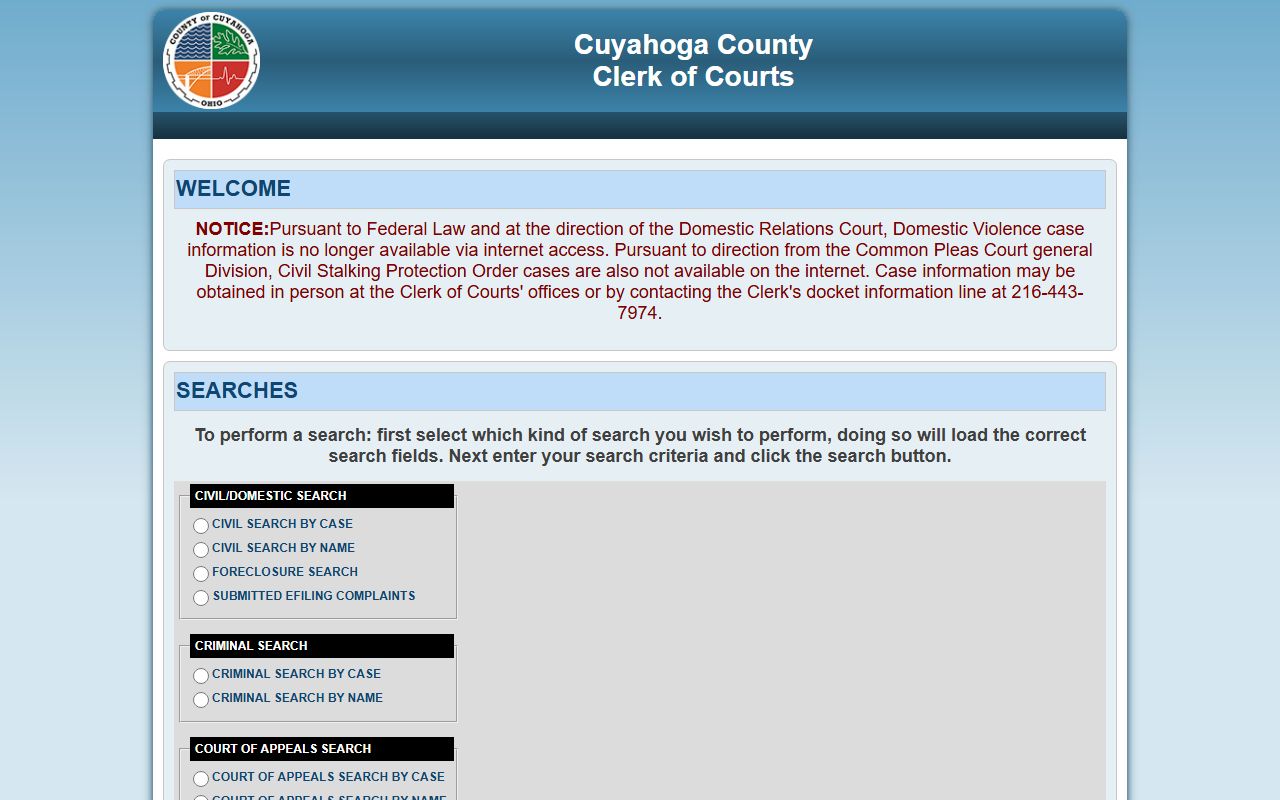
The docket search is the court-record route for charges and case events after a jail arrest.
Cuyahoga Court Search Fields
The court search form changes based on the search type. Criminal Search by Case uses a case number path. Criminal Search by Name uses party name fields and related filters. The research captured the following field inventory from the Clerk search page.
| Field Label | Type | Required | Options / Format Notes |
|---|---|---|---|
| Search type | Radio buttons | Yes | Criminal Search by Case or Criminal Search by Name; civil and appeals options are separate. |
| Case category | Dropdown | Conditional | Category options load after selecting the search type. |
| Case year | Dropdown | Conditional | Visible years depend on search type. |
| Case number | Text | Conditional | Used for Criminal Search by Case; a help link appears on the page. |
| Party role | Dropdown | Conditional | Role options depend on division and search type. |
| First / last name | Text | Conditional | Used for Criminal Search by Name after selecting that search. |
| Buttons | Button or link | Yes | Search, print, close, help, and disclaimer links appear in page data. |
Charges Filed After Arrest
The court record begins with a charging document. In Cuyahoga County felony matters, the Prosecutor's Grand Jury Unit reviews reports from law enforcement alleging felony criminal activity. If there is sufficient evidence, cases can be presented to a Cuyahoga County grand jury. The Prosecutor's General Felony Unit handles most felony indictments returned by a grand jury and works with police across Cleveland and the suburbs.
| Document | Who uses it | How it fits the case |
|---|---|---|
| Complaint | Law enforcement or prosecutor | Often starts a criminal case after arrest and states the accused offense. |
| Information | Prosecutor | A prosecutor-filed charging document used in some cases without grand-jury indictment. |
| Indictment | Grand jury | A felony charging document returned after grand-jury review. |
Michael C. O'Malley is the Cuyahoga County Prosecutor. The Prosecutor's Office is listed at 1200 Ontario Street, 9th Floor, Cleveland, OH 44113, and the research cites Prosecutor divisions and units for the General Felony and Grand Jury descriptions. Prosecutor review is why the charge list on a booking record should not be treated as the final court record.
Charge Status Terms
Cuyahoga County court records after an arrest can show several charge statuses over time. A charge may be filed, amended, reduced, dismissed, or carried into a plea, verdict, or sentencing entry. A no bill can also end a felony path after grand-jury review. Read each count on the docket separately because one case can contain charges at different stages.
| Status | What it means |
|---|---|
| Pending | The charge is active and has not reached final disposition. |
| Amended | The charge text, level, statute, or count has changed by court filing or order. |
| Reduced | The charge has been lowered to a lesser offense or lower level. |
| Dismissed | The charge was ended by court action and is not a conviction. |
| No bill | The grand jury did not return an indictment on the presented felony charge. |
| Convicted | A guilty plea, no-contest finding, or verdict has resulted in a conviction entry. |
Bond After Jail Arrest
Bond entries belong in the court record. Cuyahoga County Clerk of Courts publishes online bond posting instructions for cash or 10% felony bonds in Common Pleas cases. The process starts at the Clerk case-records site, where the depositor agrees to terms, searches by defendant name or case number, retrieves the correct case, and selects a cash or 10% bond option when the case allows it.
| Bond type | Cuyahoga County notes |
|---|---|
| Cash bond | Full cash amount paid to secure release, subject to costs, fees, and refund rules. |
| 10% bond | Some Common Pleas felony cases allow payment of 10% through the online bond path. |
| Surety bond | A licensed bail agent posts bond for a fee if the court permits surety bond. |
| Personal recognizance | Release on a promise to appear, without a cash deposit. |
| No-bond hold | Payment alone will not release the person because another hold, detainer, or court order controls custody. |
The Clerk page says a 3% processing or convenience fee is charged by the credit-card vendor whether the bond is posted online or in person. It also describes a depositor acceptance form, a state-mandated reparation fee disclosure, email confirmation after approved payment, and notice to the jail release desk. Release still depends on jail processing and any holds.
Warrants After Arrest
The Cuyahoga County Sheriff's Warrant Unit page does not provide a public searchable warrant database. It describes a unit that executes felony and civil arrest warrants, Common Pleas bench warrants, temporary protection orders, extraditions, and fugitive apprehension. The sheriff contact list gives the Records/Warrant Division phone as 216-443-6100.
Warrant entries can also appear in court records as capias, bench warrant, failure to appear, bond forfeiture, recall, or quash entries. Municipal warrants may be held by a city or municipal court rather than the county sheriff. When an arrest is based on a county warrant, the county inmate information page says county-warrant prisoners are booked at any time. The result can be a new jail booking, a bond review, a hearing, or continued custody if another hold exists.
Victim Notices and Clerk Access
Cuyahoga County court records after an arrest may also matter to victims and witnesses who need hearing, release, or custody notice. The Cuyahoga County Witness/Victim Service Center is listed at 75 Erieview Plaza, 5th Floor, Cleveland, OH 44114, with phone 216-443-7345 and email WVS@cuyahogacounty.gov. The prosecutor victim-rights materials also route users to Ohio VINE for notice of arrest, escape, release, custody changes, and criminal-case updates.
In-person court access is separate from jail access. The Clerk footer lists the Justice Center at 1200 Ontario Street and the Old Courthouse at 1 Lakeside Avenue, with weekday office hours of 8:30 a.m. to 4:30 p.m. and a Saturday bond or cashier window from 9:30 a.m. to 12:30 p.m. The Clerk docket remains the court-record source; the sheriff app remains the jail-custody source.
Charges vs Convictions
An arrest and a charge are not the same as a conviction. Cuyahoga County court records after a jail arrest may show an accusation for months before a final outcome. The docket should be read through the latest disposition and sentencing entries, not just the first complaint or booking charge.
| Issue | Charge | Conviction |
|---|---|---|
| Stage | Accusation filed after arrest or review | Final result after plea, finding, or verdict |
| Meaning | The person is accused of an offense | The court record reflects guilt by plea, finding, or verdict |
| Can change? | Yes, charges can be amended, reduced, added, or dismissed | Changes require later court action such as appeal, sealing, or correction |
| Where shown? | Complaint, information, indictment, and docket events | Disposition, plea, verdict, sentencing, and judgment entries |
Sealed vs Expunged Records
Ohio sealing and expungement rules can limit public access after eligible outcomes. The research cites ORC 2953.33 for sealing or expungement after not guilty findings, dismissals, no bills, or pardons, and ORC 2953.34 for the effect of orders on public offices. Once an applicable order reaches an agency with records, that office must comply subject to legal exceptions.
| Issue | Sealed | Expunged |
|---|---|---|
| Public access | Hidden from ordinary public access | Removed or treated as erased to the extent the order allows |
| Official access | Some agencies may retain limited legal access | Access is narrower and controlled by the order and statute |
| Common trigger | Eligible case outcome and court order | Eligible case outcome and court order |
| Public offices | Must comply with applicable orders | Must comply with applicable orders |
Restricted Court Records
Cuyahoga County's Clerk search page includes limits. It says domestic-violence case information is no longer available by internet access under federal law and Domestic Relations Court direction. It also says civil stalking protection order cases are not available on the internet by Common Pleas General Division direction. Those records may require in-person Clerk contact or the docket information line.
Ohio public-records law, including ORC 149.43, starts from a public access rule but allows exemptions. Juvenile matters, sealed records, confidential law-enforcement investigatory material, some protected-person information, medical records, and other state or federal confidentiality rules may limit release. The Ohio Attorney General's Public Records Act guidance says the reason for a request usually does not matter, but the office can ask for details that help identify and deliver the record.
Important: Court records after arrest can be incomplete online; confirm active warrants, bond, and sealed matters with the Clerk or issuing court.